
Past / Ongoing Projects
Our projects are typically anchored to various stages in the data analytics pipeline. We have experience in these tools:
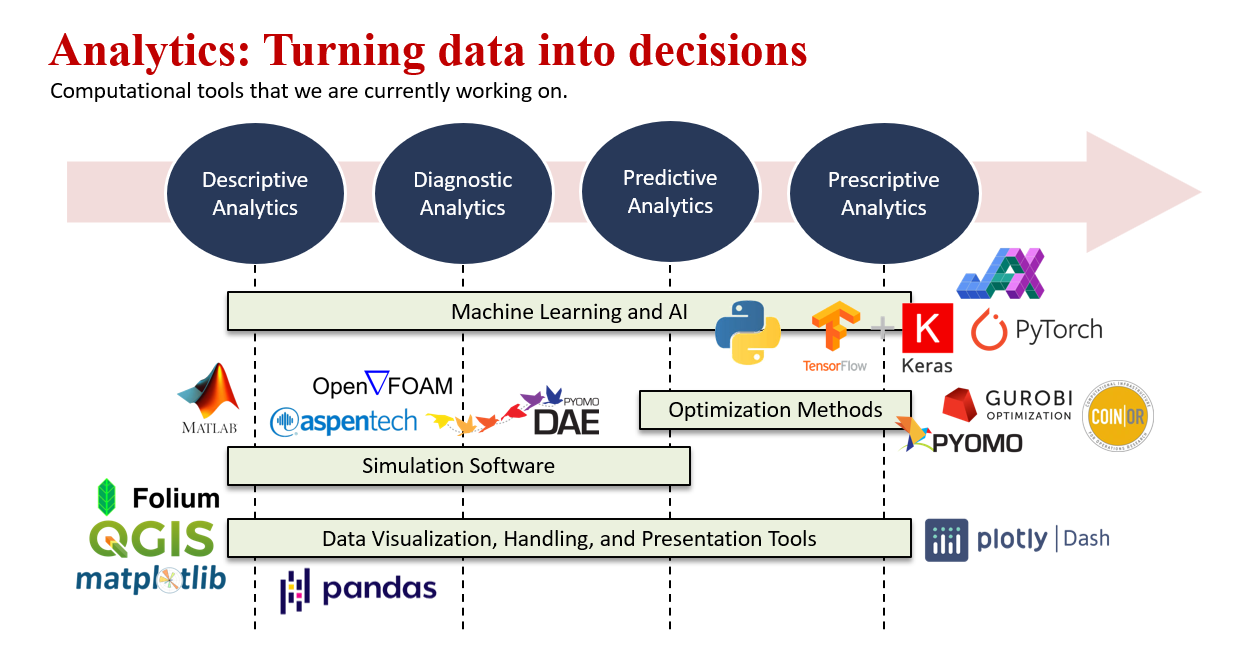
The following lists our involvement in government- and industry-funded projects:
Past Projects
- Pilot Study for Integrating Microgrids and Distributed Renewable Energy Sources for an Electric Cooperative (2021)
- Role: Project Staff
- Funding agency: DOST CRADLE (Collaborative Research and Development to Leverage the Philippine Economy) Program
- Computational Design of High Entropy Alloys for Catalyst and Battery Applications (2022)
- Role: Project Staff
- Funding agency: DOST PCIEERD (Philippine Council for Industry, Energy, and Emerging Technology Research and Development)
- Won the DOST-PCIEERD Excellence in Project Implementation and Completion (EPIC) Award, June 2026
Ongoing Projects
- Renewable Energy-Powered Production of Net Zero Energy Carriers: from Emerging Catalysis to Process Engineering (2024)
- Role: Project Staff
- Funding agency: DOST PCIEERD (Philippine Council for Industry, Energy, and Emerging Technology Research and Development)
- Two-Year Collaborative Algal Bloom Research (2024)
- Role: Project Staff
- Industry Partner: Maynilad Water Services, Inc.
Open Research Questions
These are some ideas that we are currently working on. If you wish to collaborate with us, e-mail me at kspilario@up.edu.ph
- Neural Architecture Search
- If neural nets are universal approximators, can we train them to behave between 2 machine learning models? What is halfway between a Random Forest model and a Support Vector Machine? Can an autoencoder be trained halfway between t-SNE and PCA?
- If diffusion models can be trained to generate hyper-realistic images, can we use the same normalizing flows concept to fine-tune and generate effective neural net architectures?
- Where are the physics-informed neural nets and the non-physics-informed neural nets in the high-dimensional weight space? Can we constrain backpropagation to lead us closer to more physically realizable neural nets without encoding the physics?
- Are there artifacts about neural net architectures that make them better surrogates for ODEs and PDEs?
- How do we compress large trained neural nets without sacrificing accuracy?
- Can neural net generalization be connected to Hessian-based metrics of the loss landscape when applied to the surrogate modeling of industrial processes?
- Can we make neural net inference faster for surrogate-based optimization and control? How to get its inverse for explicit MPC?
- Are there artifacts about the statistics of a data set that make certain neural net architectures work better on them?
- Continual Learning
- How can neural nets continuously adapt to non-stationary industrial process behavior, for instance, during process degradation?
- Can we use the attention mechanism to attend to certain weights that can be adjusted during adaptive inference?
- Can we design a Kalman filter to adapt any nonlinear machine learning surrogate to changing process conditions at inference time?
- How to ensure stability in adaptive long short-term memory neural nets?
- Can we quickly constrain the adaptation of neural nets to remain physics-informed at inference time?
- Can we use decision trees to guide switching between different machine learning models when tracking changing operating conditions?
- Can we train a policy by reinforcement learning that learns to choose various surrogates among an ensemble?
- Other ideas
- Can we train a decision tree with Gaussian Process models at the leaves? Or use trees to mix different kernels?
- Are there alternatives to current neural operators for PDEs?
- Can we guide plant, process, or equipment design using diffusion maps and tracing safety-edge cases in the map?
- Can we measure overparametrization and apply it outside neural nets?
- Can we knowledge-distill multiple single-output Gaussian processes into multi-output recurrent neural nets?
- How to make reinforcement learning agents more sample-efficient for optimization and control?
- Can we measure the effectiveness of domain adaptation of machine learning models in a low-dimensional space?